

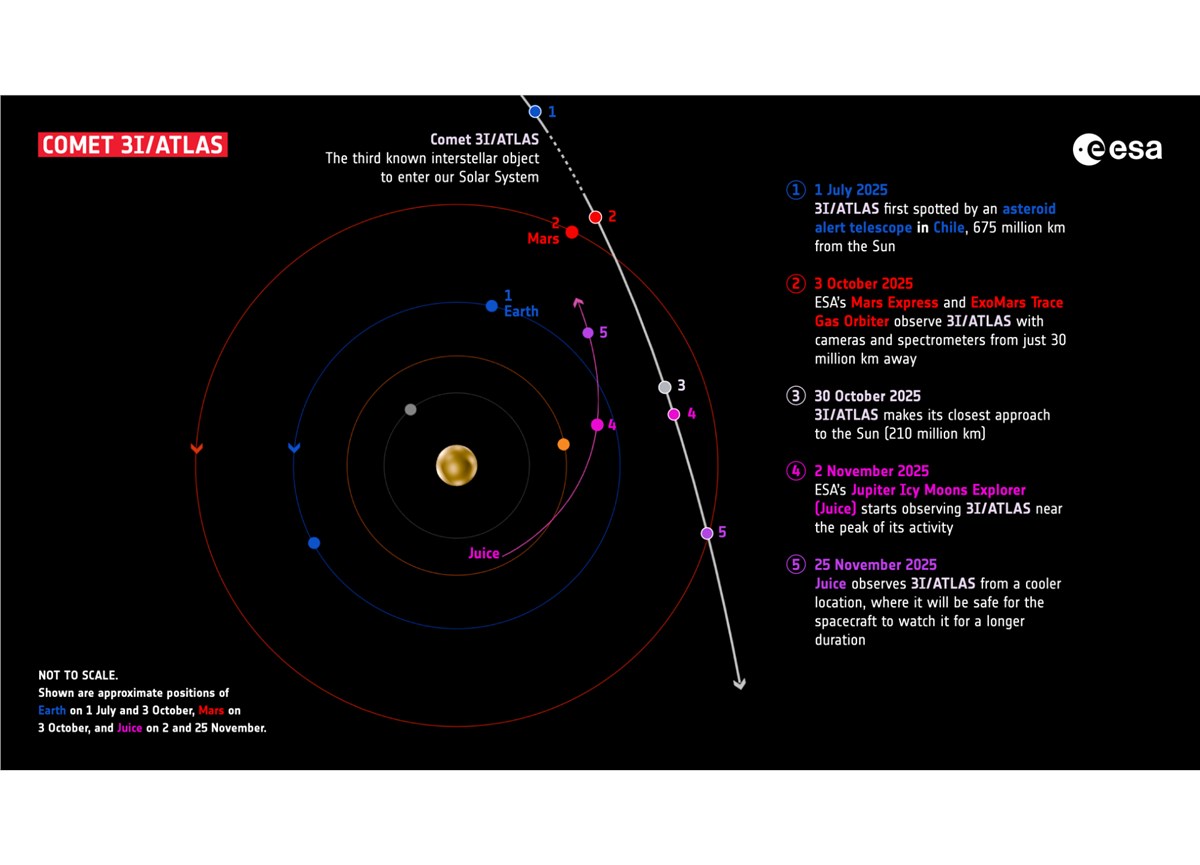
In a unique observation campaign, ESA’s ExoMars Trace Gas Orbiter (TGO) and Mars Express have observed the interstellar comet 3I/ATLAS as it passed near Mars. The two Mars orbiters, which had the closest view of any ESA spacecraft, imaged the comet from a distance of 30 million kilometres. This presented a significant challenge, as the comet is tens of thousands of times fainter than the Martian surface the cameras are designed to photograph.
The CaSSIS camera on the ExoMars TGO successfully captured the comet’s coma, the halo of gas and dust released as the comet is heated by the Sun. However, the kilometre-wide nucleus was too distant to resolve, and the faint tail was not visible. Scientists are still analysing data from Mars Express, including attempts to combine multiple images to detect the faint object. They also used spectrometers on both orbiters to try and determine the comet’s composition, though it is uncertain if the coma was bright enough for this spectral characterisation.
This interstellar comet is only the third such object ever discovered, following 1I/ʻOumuamua and 2I/Borisov. Originating from outside our Solar System, these interstellar objects are scientific treasures, carrying clues about the formation of planetary systems far from our own. Based on its trajectory, 3I/ATLAS is suspected to be the oldest comet ever observed, potentially three billion years older than our 4.6-billion-year-old Solar System.
The work continues, with future observations planned using the Jupiter Icy Moons Explorer (Juice). This research paves the way for missions like the Comet Interceptor, scheduled for launch in 2029, which is designed to wait in space for a target, ideally a pristine comet or even an interstellar object, offering a potential breakthrough in understanding these mysterious visitors from distant stars.
