

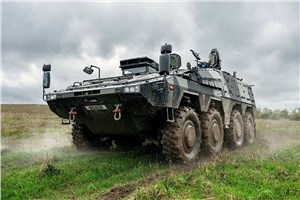
The British Army has achieved a critical milestone with its new Ajax armoured fighting vehicle, declaring Initial Operating Capability. This means a full squadron of the advanced vehicles is now officially ready for frontline operations, marking the first new armoured vehicle to enter army service in nearly three decades.
A major collaborative project between the Army, Defence Equipment & Support, and manufacturer General Dynamics, the Ajax programme is a significant economic driver. The fleet of 589 vehicles across six variants is assembled in Merthyr Tydfil, South Wales, sustaining a UK-wide supply chain of over 230 companies and supporting more than 4,100 skilled jobs.
The Ajax family is designed to provide cutting-edge reconnaissance, with state-of-the-art sensors and a powerful 40mm cannon to identify and engage enemy targets. The vehicle has undergone exhaustive testing, including firing over 20,000 rounds and driving more than 42,000 kilometres in simulated battlefield conditions—a distance equivalent to circumnavigating the globe.
Defence officials highlighted the dual benefit of the programme: enhancing national security while fuelling economic growth. “Defence is an engine for growth,” stated Minister for Defence Readiness and Industry, Luke Pollard MP. “AJAX is contributing not only to the economy in South Wales but also UK-wide in the supply chain.” The programme also holds significant export potential, with the government actively pursuing international interest.
The Household Cavalry Regiment, which will operate the initial fleet, praised the vehicle’s capabilities. Crews report a dramatic improvement over previous generations, citing unparalleled situational awareness, enhanced control, and a networked digital system that allows for continuous upgrades.
Replacing the ageing CVR(T) vehicles introduced in the 1970s, Ajax is at the heart of the Army’s modernisation strategy, forming the core of new Armoured and Deep Recce Strike Brigades. This deployment supports a wider £41 billion investment in Army equipment over the next decade, aimed at delivering a ten-fold increase in lethality through precision, connectivity, and digital advantage.
