

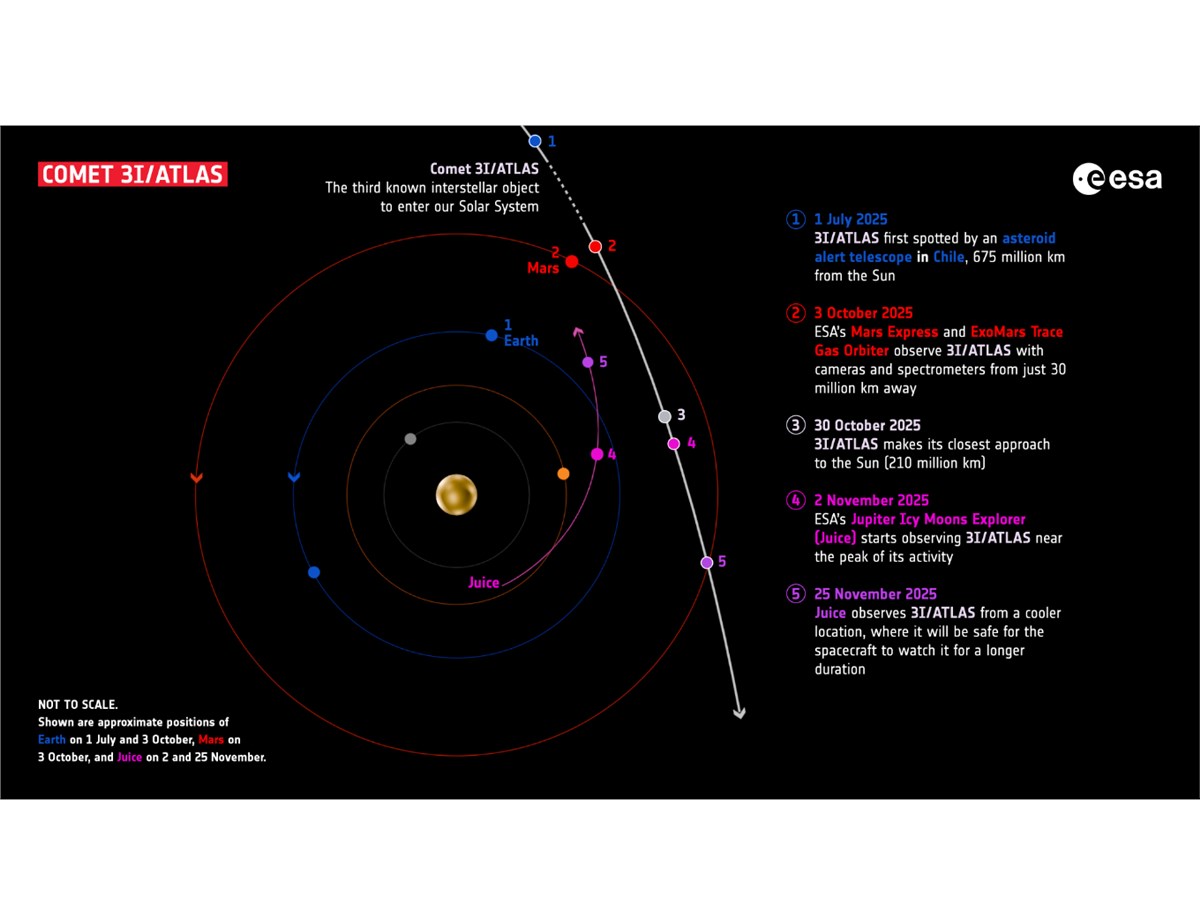
Astronomers have significantly refined the trajectory of the third known interstellar visitor, comet 3I/ATLAS, thanks to a novel observation from Mars orbit. Using data from the ExoMars Trace Gas Orbiter (TGO) spacecraft at the Red Planet, the European Space Agency (ESA) improved the precision of the comet’s predicted location by a factor of ten.
The breakthrough came in early October, when the comet passed within about 29 million kilometres of Mars. From this unique vantage point, the ExoMars TGO observed 3I/ATLAS from a new angle and at a distance roughly ten times closer than possible from Earth. By triangulating this data with terrestrial telescope observations, scientists at ESA’s Near-Earth Object Coordination Centre dramatically reduced the uncertainty in the object’s path.
This was a complex challenge, as the orbiter’s CaSSIS camera was designed for high-resolution imaging of the Martian surface, not for tracking faint, fast-moving objects in deep space. The team had to meticulously account for the spacecraft’s exact and rapidly changing position in orbit around Mars—a factor usually negligible for Earth-based observations. The successful effort marks the first time astrometric data from a spacecraft orbiting another planet has been officially submitted and accepted into the international Minor Planet Center database.
While 3I/ATLAS poses no danger and is speeding out of the Solar System at up to 250,000 km/h, the exercise proved immensely valuable for planetary defence. It demonstrated the power of using multiple, distant observation points to precisely track celestial objects, a technique that could be crucial if a future interstellar visitor or near-Earth object were on a threatening course. The operation also showcased how existing space assets, even those not designed for asteroid detection, can be leveraged to boost readiness.
The comet is now under observation by another ESA mission, the Jupiter Icy Moons Explorer (Juice), as it becomes more active after its closest approach to the Sun. Looking ahead, such fleeting interstellar visitors highlight the need for dedicated missions. ESA’s planned Comet Interceptor mission is designed to wait in space for a future target, potentially offering the first-ever close-up study of an object from another star system.
