
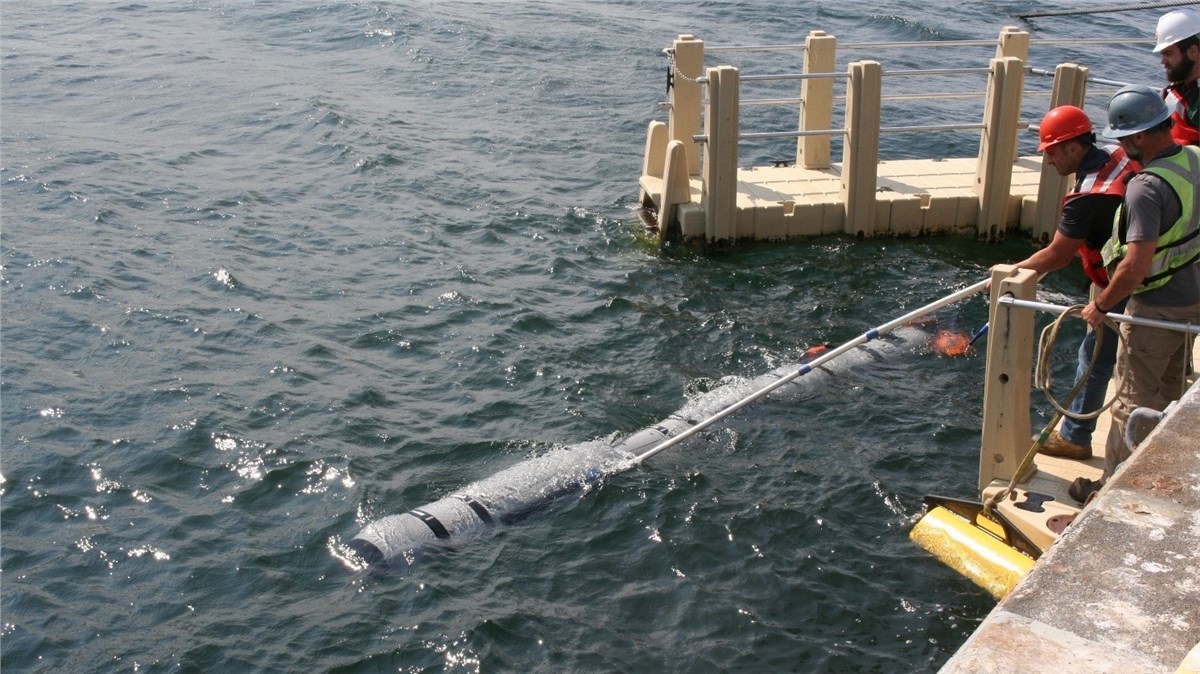
In a significant advancement for undersea operations, a collaborative team from the Woods Hole Oceanographic Institution (WHOI) and the U.S. Navy’s Naval Undersea Warfare Center Division Newport (NUWC) has successfully executed the first-ever recovery and launch of a REMUS 620 unmanned undersea vehicle (UUV) from a Virginia-class submarine torpedo tube test fixture. This milestone, conducted at Seneca Lake, New York, was achieved in less than seven months by integrating WHOI’s innovative Yellow Moray torpedo tube launch and recovery (TTL&R) system into the medium-class UUV.
The in-water test demonstrated the REMUS 620’s sophisticated capabilities, confirming its ability to perform complex autonomous navigational and communication protocols. The vehicle successfully docked with a submerged shock and fire enclosure capsule (SAFECAP) loaded into the torpedo tube fixture. Furthermore, the test period validated a reverse swimout launch, where the vehicle demonstrated safe separation from the tube, proving a complete launch and recovery cycle.
Duane Fotheringham, president of the Unmanned Systems group at HII, highlighted that this success validates extensive research and development efforts. The achievement was accelerated by leveraging WHOI’s three years of prior TTL&R expertise, allowing HII’s REMUS 620 engineers to rapidly reach this critical point. Carl Hartsfield of WHOI’s Oceanographic Systems Lab praised the highly compressed schedule, noting that the teams quickly conducted tests, evaluated data, and made substantive adjustments to the vehicle. He credited the exceptional teamwork and professionalism between WHOI, NUWC Division Newport, and HII for the flawless execution of the testing phases, also commending the outstanding support provided by the NUWC team at Seneca Lake. This event marks a major step forward for the U.S. Navy Submarine Force in expanding its capabilities for deploying autonomous systems from its submarines.
