

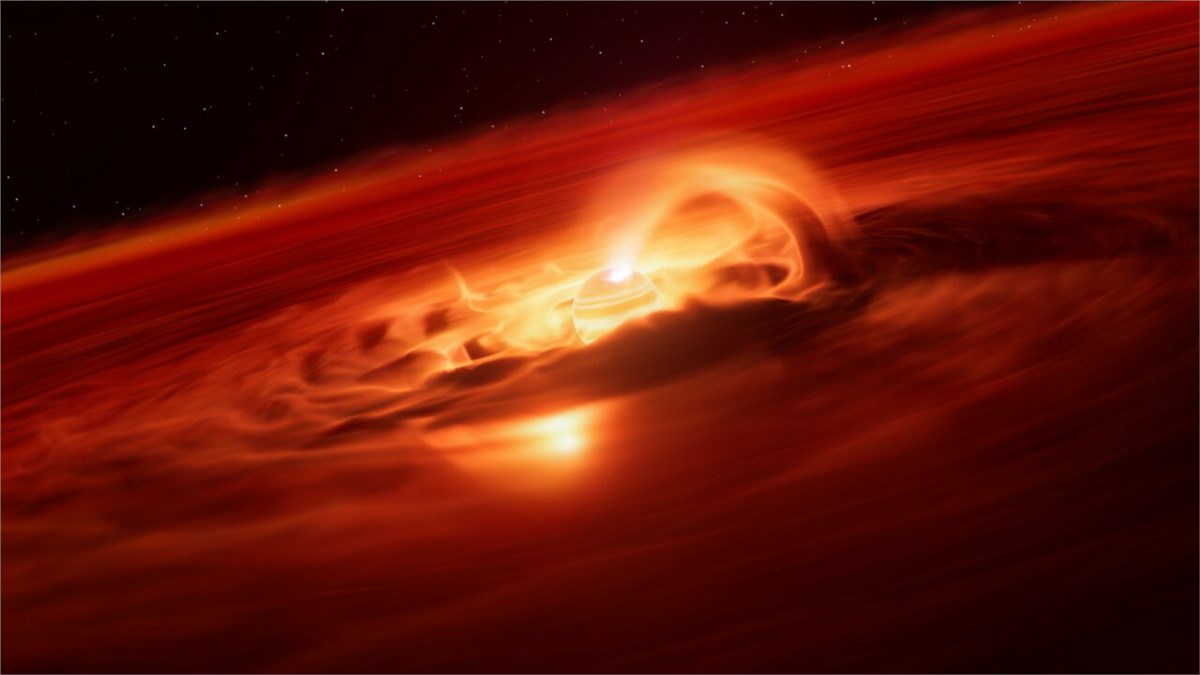
Astronomers using the European Southern Observatory’s Very Large Telescope (VLT) have discovered a record-breaking ‘growth spurt’ in a rogue planet, a free-floating world not bound to any star. This object, with a mass five to ten times that of Jupiter, is accreting material from its surrounding disc of gas and dust at an astonishing rate of six billion tonnes per second. This is the strongest accretion rate ever recorded for any planetary-mass object.
The rogue planet, officially named Cha 1107-7626 and located 620 light-years away, demonstrates that these solitary worlds can be dynamic and exciting. The research team, led by Víctor Almendros-Abad, found that the accretion process is not steady. By August 2025, the planet was consuming material about eight times faster than just months prior. This discovery, published in The Astrophysical Journal Letters, was made possible by the X-shooter spectrograph on the VLT, with supporting data from the James Webb Space Telescope.
The findings provide crucial insights into the formation of rogue planets, whose origin is a major open question in astronomy. The observed accretion burst, similar to phenomena seen in young stars, suggests that at least some rogue planets may form in a star-like manner, blurring the line between stars and planets. The study also revealed that magnetic activity played a key role in driving this dramatic infall of mass, a process previously only associated with stars. Furthermore, the chemistry of the disc changed during the event, with the new detection of water vapour.
This discovery offers a valuable sneak peek into the earliest formation periods of these enigmatic objects. The upcoming Extremely Large Telescope (ELT) will further revolutionize this field, enabling astronomers to uncover and study more of these faint, lonely planets and better understand their star-like nature.
